 Written by
 Why This Question Matters
If you’ve ever spent months drilling verb conjugations, memorizing flashcard decks, or grinding through grammar workbooks — only to freeze the moment a native speaker talks to you at normal speed — you’ve experienced the core failure of traditional language instruction firsthand.
You didn’t fail the method. The method failed you.
Over the last four decades, a growing body of research in linguistics, cognitive science, and second-language acquisition (SLA) has quietly been building the case for a fundamentally different approach: story-based, comprehensible input. This literature review synthesizes the key findings from that research and explains why narrative comprehension is not just a nice alternative to grammar drilling — it is, according to the evidence, the superior path to fluency for adult learners at the B1–C1 level.
I. The Foundation: Krashen’s Comprehensible Input Hypothesis
Any serious discussion of story-based language acquisition starts with Stephen Krashen, whose Input Hypothesis (1982) remains one of the most influential — and debated — frameworks in applied linguistics.
Krashen’s central claim is deceptively simple: language is not consciously learned through explicit instruction; it is unconsciously acquired through meaningful exposure. Specifically, he argues that acquisition happens when learners receive input that is comprehensible and set just slightly above their current level — a condition he calls “i+1” (current competence, plus one step).
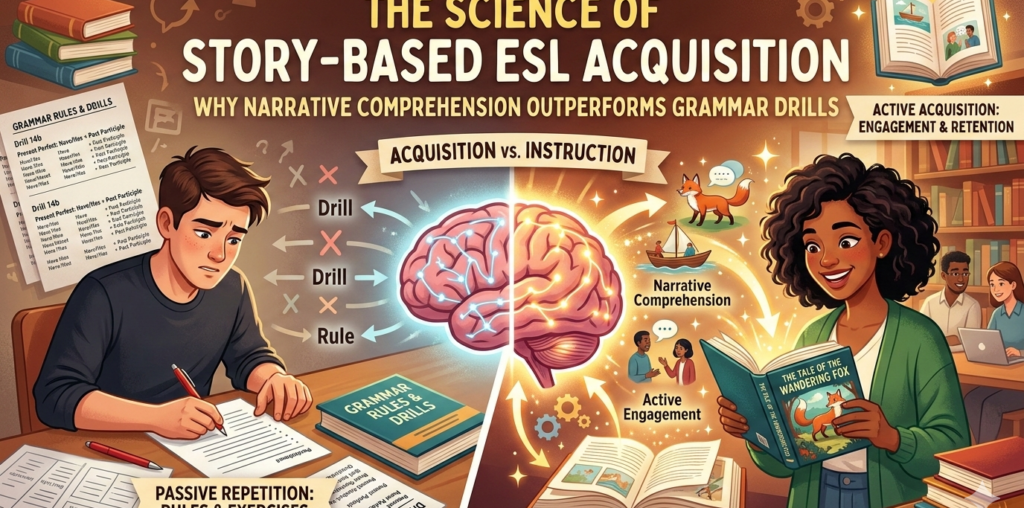
Acquisition vs. Learning: A Critical Distinction
Krashen draws a sharp line between two processes that most people conflate:
• Language acquisition is subconscious. It’s the same process children use when absorbing their first language — no rules, no drilling, just meaning-making through exposure.
• Language learning is conscious. It’s knowing that the past perfect exists, what it’s called, and when a textbook says to use it.
The uncomfortable implication? Consciously learned grammar rules rarely transfer into spontaneous, fluent speech. Krashen (1982, 1985) argues that explicit learning serves mainly as a “monitor” — a slow, effortful editor that kicks in when you have time to think, not when you’re mid-conversation. This distinction has enormous practical consequences. It means that the goal of ESL instruction shouldn’t be to load students with grammatical knowledge. It should be to engineer repeated, low-anxiety exposure to comprehensible, meaningful language — so that acquisition, not just learning, can take place.
The Affective Filter
Krashen also introduced the concept of the Affective Filter — a metaphorical barrier that goes up when learners feel anxious, bored, or self-conscious, blocking input from being processed even when it’s technically comprehensible. High-stress grammar tests, public correction, and rote drilling all raise the filter. Engaging stories, relatable characters, and low-stakes listening lower it.
This is not soft pedagogy. It’s a structural explanation for why emotionally engaging content produces better acquisition outcomes than anxiety-inducing drills.
II. Why Stories? The Cognitive Case for Narrative
Krashen gave us the “what” — comprehensible input. But why is narrative the most effective vehicle for delivering it?
The Brain Is Wired for Story
Cognitive linguist Mark Turner (1996) argues that narrative is not just a literary device but a fundamental structure of human thought — what he calls “the literary mind.” We process the world in stories: sequences of events, cause and effect, characters with intentions and outcomes. This is not metaphorical. Neuroscientific research using fMRI imaging (Mar, 2011) shows that story comprehension activates significantly more areas of the brain than isolated factual processing, including regions governing language, sensory simulation, and emotion.
When you encounter a grammar rule in isolation (“Use the subjunctive after expressions of doubt”), only your analytical brain engages. When you encounter that same grammar structure embedded in a story where a character is uncertain about a decision, far more of your cognitive architecture lights up — and the language is more likely to stick.
Schema Theory and Contextual Embedding
Bartlett (1932) and later Rumelhart (1980) developed schema theory, which holds that comprehension depends on activating existing mental frameworks to make sense of new information. Stories are schema-rich: they have predictable arcs, familiar character types, recognizable emotional patterns. This scaffolding means that even when individual words are unknown, the narrative context gives learners enough to extract meaning — which is precisely what comprehensible input requires.
Research by Schlepegrell and Colombi (2002) on academic language development found that learners embedded in narrative and discourse-level tasks outperformed those focused on sentence-level grammar instruction on measures of both accuracy and fluency over time.
III. Story-Based Input vs. Grammar Instruction: What the Research Shows
The debate between implicit, input-based approaches and explicit grammar instruction has generated hundreds of studies. The findings are not always tidy, but several patterns are robust.
Implicit Acquisition Produces More Durable Fluency
VanPatten and Williams (2007) synthesized decades of SLA research and concluded that learners who receive abundant comprehensible input develop more nativelike intuitions about grammar than those who receive explicit rule instruction — even when the explicit-instruction group scores higher on discrete grammar tests.
This makes intuitive sense. Scoring well on a present-perfect quiz requires memorized rules. Deploying present-perfect naturally in conversation requires an internalized sense of when it sounds right — which only comes from repeated, meaningful exposure.
The Superiority of Extensive Listening and Reading
Nation and Newton (2009) reviewed research on extensive reading and listening — consuming large volumes of comprehensible text and audio — and found consistent gains in vocabulary, grammar, and oral fluency compared to intensive, instruction-heavy approaches. Critically, these gains were strongest in learners who were motivated and engaged by the material — which brings us back to the affective filter.
Stories, by their nature, are motivating in a way that grammar exercises are not. Learners want to know what happens next. That desire to continue engaging is itself a fluency accelerator.
Grammar Drills: Not Useless, But Misapplied
To be fair to the research: explicit grammar instruction is not worthless. Norris and Ortega (2000) conducted a meta-analysis finding that explicit instruction does produce measurable short-term gains on form-focused tasks. However, these gains show limited transfer to free production and tend to decay without meaningful input to reinforce them.
The most honest synthesis of the evidence is this: grammar instruction works best as a minor supplement to massive comprehensible input, not as the primary driver of acquisition. For B1–C1 professionals who already have a grammatical foundation, the evidence strongly favors shifting the balance toward extensive, engaging, story-driven input.
IV. Story-Based Learning for Adult Professionals: Why B1–C1 Is the Sweet Spot
Adult learners at the B1–C1 level occupy a uniquely productive position for story-based acquisition. They already have enough English to make most story-based content comprehensible. They have the cognitive maturity to engage with complex narratives. And they are typically motivated by real-world outcomes — professional credibility, conference fluency, client communication — that grammar drills simply cannot simulate.
The Problem With Adult Instruction
Long (1990) and others have noted that adult language instruction disproportionately relies on explicit teaching because adults expect it — they want explanations, rules, and structure. This expectation is understandable but ultimately works against acquisition. Adults are capable of implicit learning; they simply need to be given enough high-quality input and enough patience to let the process unfold.
Lichtman (2016) reviewed research comparing implicit and explicit learning in adult second-language learners and found that adults showed robust implicit learning under the right conditions — specifically, when the input was frequent, varied, and meaningful. Stories check all three boxes.
After years of working with B1–C1 professionals in Colombia and Costa Rica, I can identify the moment a learner shifts from acquisition to conscious monitoring in real time. There is a visible pause — a slight disconnect between thought and speech — that signals the learner has left the flow of communication and entered a mental grammar review. The research calls this the Monitor in action. In the classroom, it looks like fluency hitting a wall. In practice, I have found two interventions that address it directly: for learners who have access to a conversation partner, structured conversation in the target language breaks the monitoring habit under real communicative pressure; for those working alone, consistent consumption of target language content serves the same function. Either way, immersion delivered consistently over time is the only method I have observed that reduces that pause without the learner consciously trying to reduce it.
Authentic Language in Context
For professionals, one of the biggest gaps in traditional ESL instruction is the absence of authentic, contextually rich language use. Business English courses teach scripted dialogues and formal register. Stories — especially contemporary fiction, narrative journalism, and audio drama — expose learners to the full register range of real English: informal contractions, discourse markers, hedging, idiom, and the rhythms of natural speech.
Gilmore (2007), reviewing research on authentic versus pedagogic materials, found that authentic materials consistently produced higher gains in pragmatic competence — the ability to use language appropriately in real social contexts — compared to sanitized textbook materials.
This pragmatic gap showed up in an unexpected pattern across my corporate teaching experience. Among the professionals I worked with — accountants, bankers, and marketers — the marketers consistently demonstrated faster acquisition progress despite equivalent instruction. My working hypothesis is that their professional culture normalizes iteration over perfection: a campaign either converts or it doesn’t, and the response is to test another. Applied to language, a wrong verb tense becomes data, not embarrassment. The Affective Filter, in that context, stays low by professional default — not because the learner studied harder, but because failure carries less social weight in their daily work.
V. Comprehensible Input in Practice: What “Story-Based” Actually Means
It’s worth being precise about what story-based, comprehensible input looks like in practice, because the term can become vague.
Effective story-based ESL input has four characteristics:
1. It is comprehensible (i+1). At least 95–98% of the vocabulary is known or inferable from context (Nation, 2001). Learners are not decoding; they are understanding — and acquiring through that understanding.
2. It is meaningful and engaging. The learner cares about what happens. This is not a nicety; it directly affects how deeply the language is processed and how much of the affective filter is lowered.
3. It is delivered in quantity. Single exposures are rarely sufficient for acquisition. Research on vocabulary acquisition (Nation, 2001; Webb, 2007) suggests that 10–20 meaningful encounters with a word in context are needed before it becomes part of a learner’s active repertoire. Stories, by nature, recycle vocabulary and structures across scenes and chapters.
4. It includes audio. For adult professionals specifically, listening fluency is often the weakest link. Reading alone builds vocabulary; listening builds the phonological representations, speech-rate tolerance, and real-time processing speed that fluency requires. Story-based audio — podcasts, audiobooks, graded readers with audio, drama — is therefore particularly valuable.
VI. Synthesis: What the Research Actually Tells Us
Drawing together the strands of this review, the evidence points to a consistent conclusion:
For adult learners at the B1–C1 level, story-based comprehensible input is the most research-supported path to durable, natural-sounding English fluency. Not because grammar is irrelevant, but because:
Acquisition — the subconscious internalization that drives fluent production — requires meaningful, comprehensible exposure, not rule memorization (Krashen, 1982, 1985).
Narrative is the most cognitively natural and emotionally engaging vehicle for that exposure (Turner, 1996; Mar, 2011).
Extensive input in context produces more durable fluency gains than intensive grammar instruction (VanPatten & Williams, 2007; Nation & Newton, 2009).
Authentic, story-rich materials build pragmatic competence that textbooks cannot replicate (Gilmore, 2007).
Adult learners are fully capable of implicit acquisition when given sufficient, high-quality input (Lichtman, 2016).
A Note on Methodology
The content on this site is grounded in peer-reviewed research in second-language acquisition, cognitive linguistics, and educational psychology. Where the research is unsettled or contested, we say so. Where it is robust, we apply it. Our goal is not to sell a philosophy — it is to give adult English learners an accurate picture of what the science actually supports, so they can make informed decisions about how they spend their study time.
References
Bartlett, F. C. (1932). Remembering: A study in experimental and social psychology. Cambridge University Press.
Gilmore, A. (2007). Authentic materials and authenticity in foreign language learning. Language Teaching, 40(2), 97–118.
Krashen, S. D. (1982). Principles and practice in second language acquisition. Pergamon Press.
Krashen, S. D. (1985). The input hypothesis: Issues and implications. Longman.
Lichtman, K. (2016). Age and learning environment: Are children implicit second language learners? Journal of Child Language, 43(3), 707–730.
Long, M. H. (1990). Maturational constraints on language development. Studies in Second Language Acquisition, 12(3), 251–285.
Mar, R. A. (2011). The neural bases of social cognition and story comprehension. Annual Review of Psychology, 62, 103–134.
Nation, I. S. P. (2001). Learning vocabulary in another language. Cambridge University Press.
Nation, I. S. P., & Newton, J. (2009). Teaching ESL/EFL listening and speaking. Routledge.
Norris, J. M., & Ortega, L. (2000). Effectiveness of L2 instruction: A research synthesis and quantitative meta-analysis. Language Learning, 50(3), 417–528.
Rumelhart, D. E. (1980). Schemata: The building blocks of cognition. In R. J. Spiro, B. C. Bruce, & W. F. Brewer (Eds.), Theoretical issues in reading comprehension. Erlbaum.
Schlepegrell, M. J., & Colombi, M. C. (Eds.). (2002). Developing advanced literacy in first and second languages. Erlbaum.
Turner, M. (1996). The literary mind. Oxford University Press.
VanPatten, B., & Williams, J. (Eds.). (2007). Theories in second language acquisition: An introduction. Erlbaum.
Webb, S. (2007). The effects of repetition on vocabulary knowledge. Applied Linguistics, 28(1), 46–65.